What is UVSim3D?
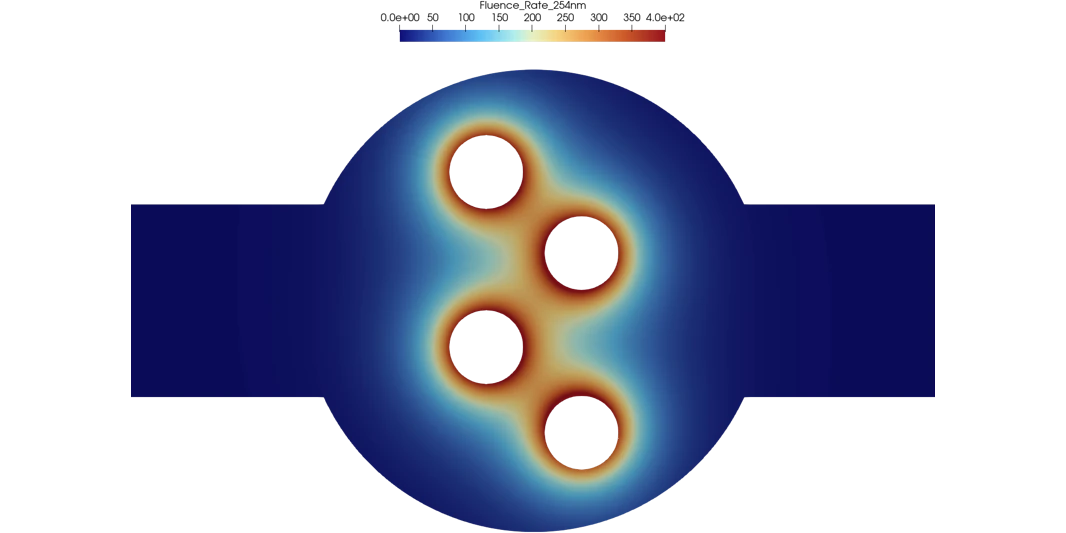
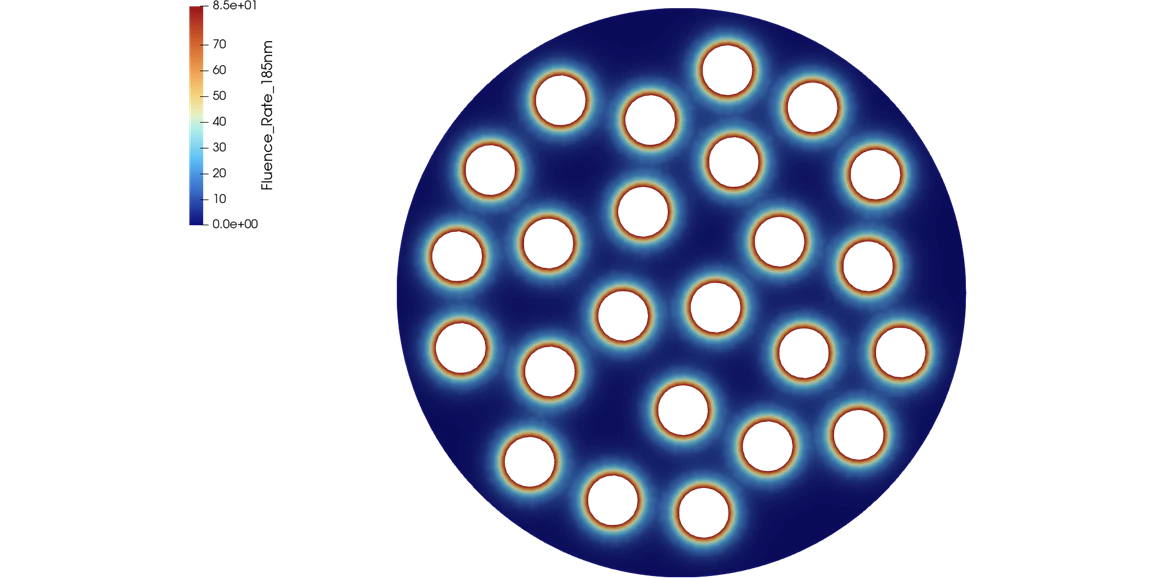
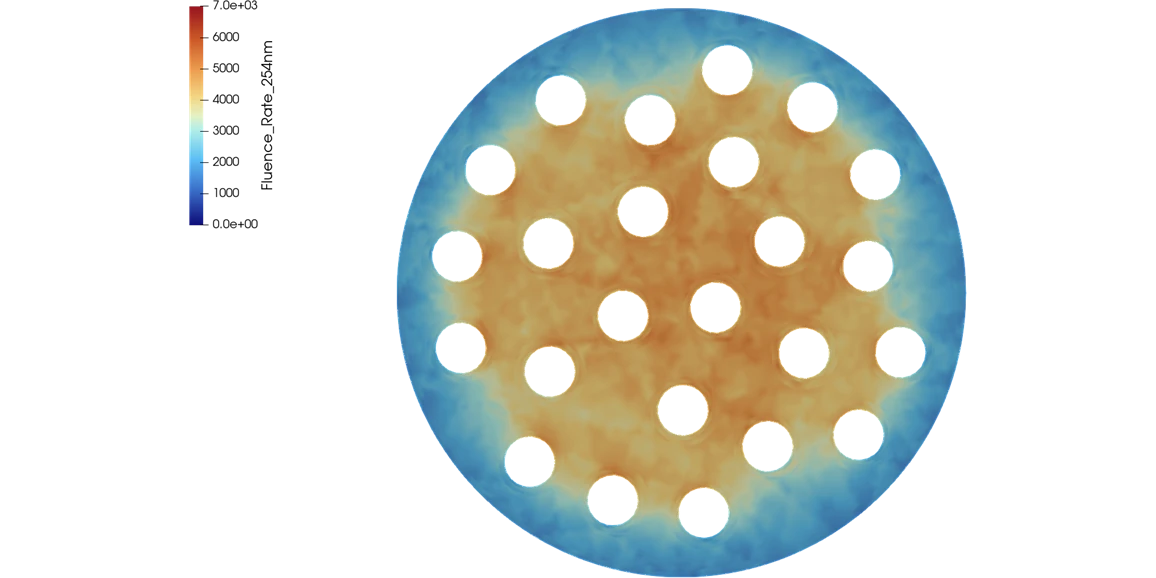
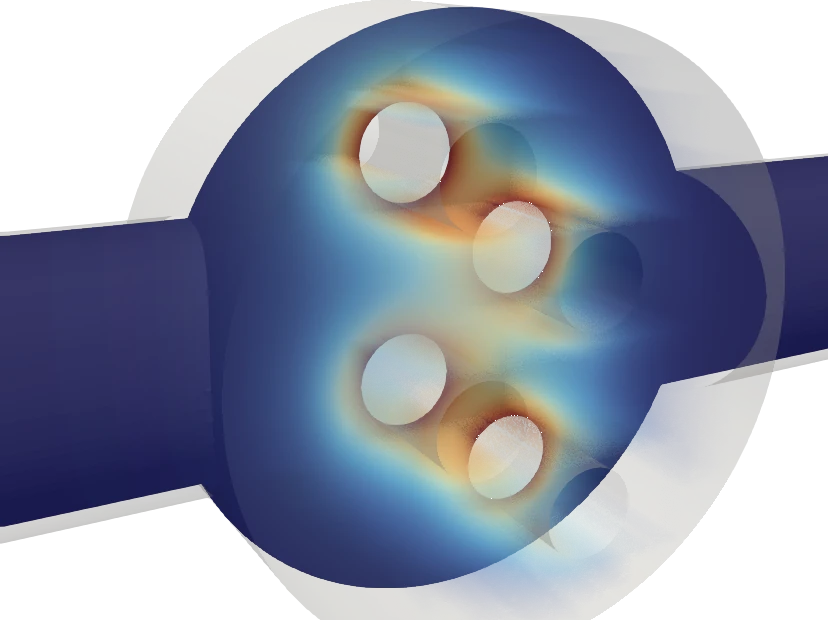
UVSim3D is engineering software that computes the ultraviolet fluence rate distribution inside UV and VUV reactors in three dimensions.
In water treatment, ultrapure water (UPW), advanced oxidation processes (AOP) and photochemical reactor design, the essential task is to quantify a UV dose distribution that varies sharply in space with lamp power, arrangement and water quality.
UVSim3D computes the fluence rate inside the reactor using physics-based radiation models and numerical methods, and returns results in a form engineers can take straight into design and performance evaluation.
- Physics-based UV dose computation
- Handles large 3D meshes
- CFD coupling
- Automation and batch processing
- Ready for design, research and verification
Problems it solves
- It is hard to know how UV dose is actually distributed inside a reactor
- Comparing performance as lamp count, power and arrangement change is difficult
- Design verification that relied on experiment needs replacing with quantitative computation
- CFD results and UV dose computation need to be coupled
- Fast, reproducible UV computation is needed on large meshes
UVSim3D addresses these through computation rather than experiment.
Key features
- · UV fluence rate (W/m²) at any point inside the reactor
- · LP and MP lamps supported
- · Single-wavelength and multi-wavelength (VUV/UV) modelling
- · Compare different lamp arrangement scenarios
- · Accounts for dimming and lamp efficiency (eta)
- · Includes shadowing between lamps
- · Handles hundreds of thousands to tens of millions of points
- · OpenMP multicore parallel computation
- · VTKHDF format for large meshes
- · Uses CFD meshes (VTU, CGNS and others) directly
- · Writes fluence rate back as a mesh field
- · Combines with residence time to compute UV dose
- · CLI batch execution
- · Reproducible simulation from JSON configuration files
- · Python wrapper for post-processing and parametric studies
How it computes
UVSim3D runs a computation in four steps.
- 01 Define the reactor
Lamp specification, arrangement, wavelength band and water quality characteristics.
- 02 Load the computation points
Supply them as text or as a CFD mesh.
- 03 Run the radiation model
Compute UV fluence rate using MPSS, MSSS or DO models.
- 04 Export results
Save per-point UV fluence rate as text, VTU, VTKHDF and other formats.
Where it applies
- UV disinfection reactors for water and wastewater
- Ultrapure water (UPW) processes
- Advanced oxidation processes (AOP)
- Photochemical reactor design and research
- UV/VUV lamp performance evaluation
- Design verification in labs and engineering teams
System environment
- Operating system
- Windows / Linux / macOS
- Input formats
- TXT, VTU, VTKHDF, CGNS
- Output formats
- TXT, VTU, VTKHDF
- Parallelism
- Multicore CPU (OpenMP)